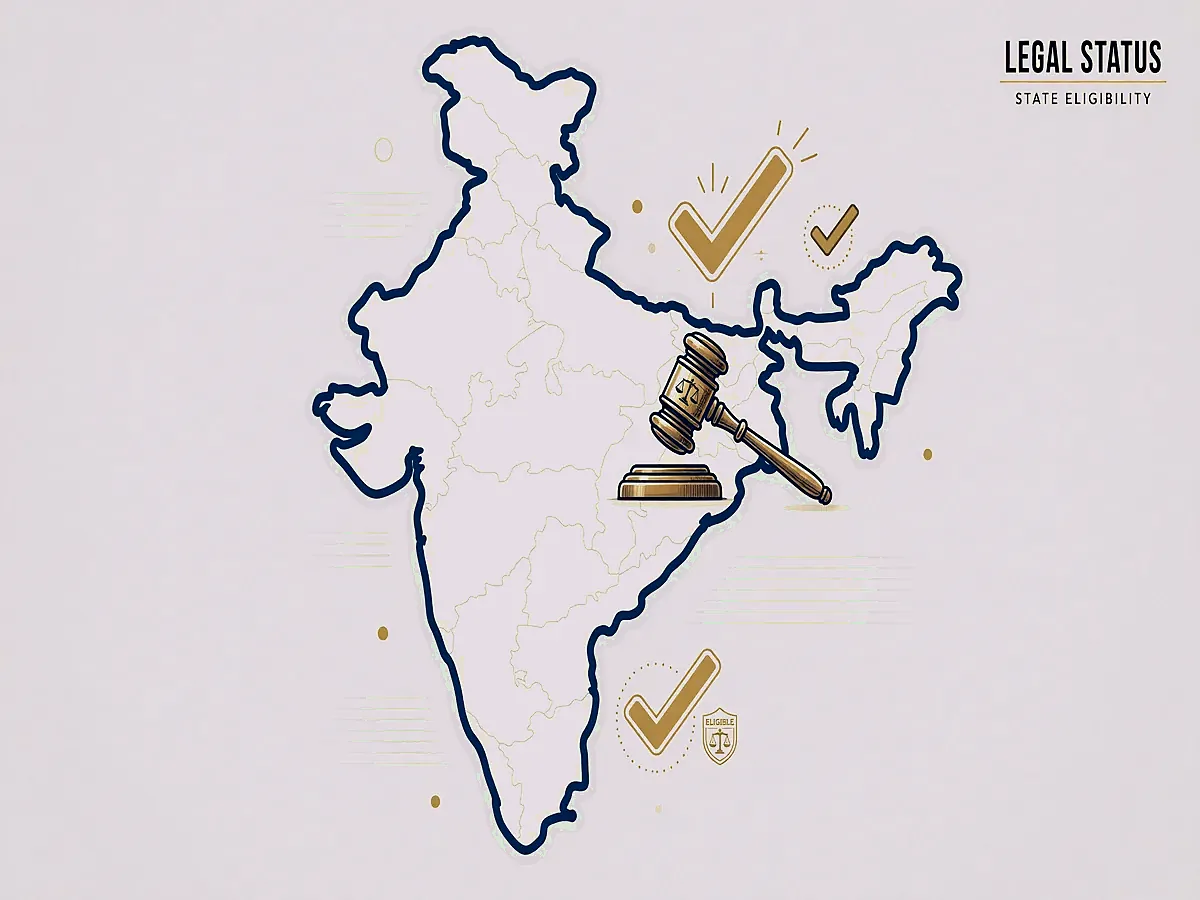
Indian fantasy-cricket regulation is state-by-state. Below is the public picture as of our last check — always confirm in the operator’s terms before signing up. We do not invent jurisdiction verdicts.
The Public Gambling Act, 1967
The Public Gambling Act, 1967 is the central law that prohibits running or being in charge of a public gambling house. The Act carves out “games of skill” from “games of chance”. Indian courts have generally held that fantasy cricket — with its player-selection component and statistical analysis — qualifies as a game of skill, not chance.
State rules vary

A small set of Indian states currently restrict paid fantasy contests. Rules change — verify before you play.
Public picture — state rules (subject to change)
Last full review · confirm with operator terms| State / UT | Status | Notes |
|---|---|---|
| Maharashtra | Permitted with conditions | Confirm operator terms |
| Karnataka | Permitted with conditions | Past litigation; verify current rules |
| Tamil Nadu | Permitted with conditions | Past ordinance; verify current rules |
| Delhi | Permitted | Standard fantasy rules |
| Gujarat | Permitted | Standard fantasy rules |
| West Bengal | Permitted | Standard fantasy rules |
| Rajasthan | Permitted | Standard fantasy rules |
| Telangana | Restricted for some games | Verify per operator |
| Andhra Pradesh | Restricted | Past ordinance on paid fantasy |
| Assam | Restricted | State-specific restrictions apply |
| Odisha | Restricted | State-specific restrictions apply |
| Sikkim | Restricted | State-specific restrictions apply |
| Nagaland | Restricted | State-specific restrictions apply |
| Meghalaya | Restricted | State-specific restrictions apply |
| Other states / UTs | Generally permitted | Confirm with operator terms |

What the operator is responsible for
The operator is responsible for: enforcing state-level eligibility at signup, verifying user identity (KYC), maintaining a responsible-play framework (deposit limits, self-exclusion), and publishing terms that comply with applicable law. The desk does not enforce these on the operator’s behalf; we report what is publicly verifiable.
What you are responsible for

Confirming your state eligibility
Before you deposit, confirm that your state permits paid fantasy contests. The operator’s terms are the source.
Confirming your age
You must be 18+ to participate in real-money fantasy contests. Age verification is the operator’s responsibility; honest disclosure is yours.
Reading the terms
Every operator publishes terms. Read them. They are the only binding agreement between you and the operator.
Not legal advice: This page is an editorial summary, not legal advice. For jurisdiction-specific questions, consult a qualified lawyer or the relevant state government publication.
Games of skill vs. games of chance
The Public Gambling Act carves out “games of skill” from “games of chance”. Indian courts have generally held fantasy cricket to be a game of skill because of its player-selection component, its statistical analysis and its dependence on domain knowledge. The classification has been challenged in some states; the legal picture is settled in most states but not all.

MeitY and the PROG Act context

India’s information-technology regulation (MeitY) sets the framework for online intermediaries and consumer-protection rules. The proposed PROG Act (Promotion and Regulation of Online Gaming Act) has been discussed in Parliament; its current status and exact provisions are matters of public record and change as legislative processes unfold. For a current fantasy-cricket operator’s compliance, the operator’s own terms and the relevant state rules are the practical reference.
Tax implications for fantasy-cricket winnings
Indian fantasy-cricket winnings above ₹10,000 in a single contest are subject to TDS at 30% (plus applicable surcharge and cess). Winnings from multiple contests are not aggregated; each contest is independent. Operators deduct TDS at the time of withdrawal or at the end of the financial year, depending on the platform. Read the operator’s terms for the exact TDS procedure and keep your PAN details accurate to avoid TDS mismatches.
Consumer-protection frameworks
The Consumer Protection Act, 2019 and the Information Technology Act, 2000 (with MeitY rules) form the consumer-protection framework for online services in India. Fantasy-cricket operators fall within this framework. The National Consumer Helpline (1915) and the INGRAM portal are the entry points for consumer complaints. State-level consumer commissions handle disputes up to a defined monetary threshold; higher-value disputes go to the State or National Commission.

How the desk tracks regulatory changes
The desk re-checks state-level eligibility before every public update. The sources we lean on: the operator’s terms page, the relevant state government publications, and the Ministry of Electronics and Information Technology (MeitY) updates. A change in any of these sources flips the status flag in the verification matrix.
A note for international readers
This page describes the Indian regulatory framework for fantasy cricket. International readers should consult their own jurisdiction’s rules; the desk does not provide jurisdiction-specific advice outside India. Most international jurisdictions treat fantasy cricket as a game of skill and permit paid contests for adults; a small number of jurisdictions restrict them. Verify locally.
The desk is not a lawyer
The desk is an editorial surface, not a legal adviser. This page is an editorial summary, not legal advice. For jurisdiction-specific questions, consult a qualified lawyer; for consumer-protection issues, contact the National Consumer Helpline (1915); for data-protection issues, contact the relevant data-protection authority.
What regulatory changes look like
A regulatory change usually appears in one of three places: an operator’s terms update, a state government notification, or a central government publication. The desk tracks all three. When a change appears, the verification matrix flips the relevant axis flag and the relevant guide is updated with the new information. The date stamp on each guide tells you when the change was incorporated.
Verifying locally
To verify state-level eligibility locally: open the relevant state government’s public-gambling or online-gaming portal; search for the current rules; check the date of the most recent publication. The desk’s state-by-state table is a summary; the underlying state publication is the authoritative source. If you find a discrepancy, send it via the contact form and the desk will update the table.
A legal recap
Real-money fantasy cricket is permitted in most Indian states for adults 18+. A small set of states currently restrict paid fantasy contests. The list changes — verify with the operator before depositing. The desk’s state-by-state table is a summary; the underlying state publication is the authoritative source. The desk is not a lawyer; for jurisdiction-specific questions, consult a qualified lawyer.
Questions readers ask
Is fantasy cricket legal in India?
Real-money fantasy cricket is permitted in most Indian states for adults 18+. A small set of states currently restrict paid fantasy contests. The list changes — verify with the operator before depositing.
Will the rules change in 2026?
Indian fantasy-cricket regulation is reviewed periodically. The desk tracks publicly available regulatory updates and re-checks the rules before each publication.
Where do I file a consumer complaint?
For consumer-protection issues, the National Consumer Helpline (1915) and the INGRAM portal are the relevant channels. For gambling-specific concerns, contact the relevant state authority.
Open the editorial app entry
Verify the current offer in your own account, then play only what you can afford to lose.