
An independent review has a single job: report what can be verified on the operator’s own page, name what cannot be verified, and avoid making a recommendation the desk cannot defend. This page does exactly that.
Review methodology

The desk reviews a fantasy-cricket platform across five axes: operator identity, app availability, KYC and withdrawal flow, scoring system, and responsible-play tooling. Each axis has a status flag: Verified, Provisional, or Watch. Status flags are re-checked before every public update.
The five axes

Operator identity
Who runs the platform? Public registry, company filings, terms-page entity.
App availability
Where to download, current version, official app store listing.
KYC & withdrawal
Documents required, processing time, common failure points.
Scoring system
Worked examples, role-specific points, multiplier rules.
Responsible play
Deposit limits, self-exclusion, state helplines, age gating.

Verification matrix
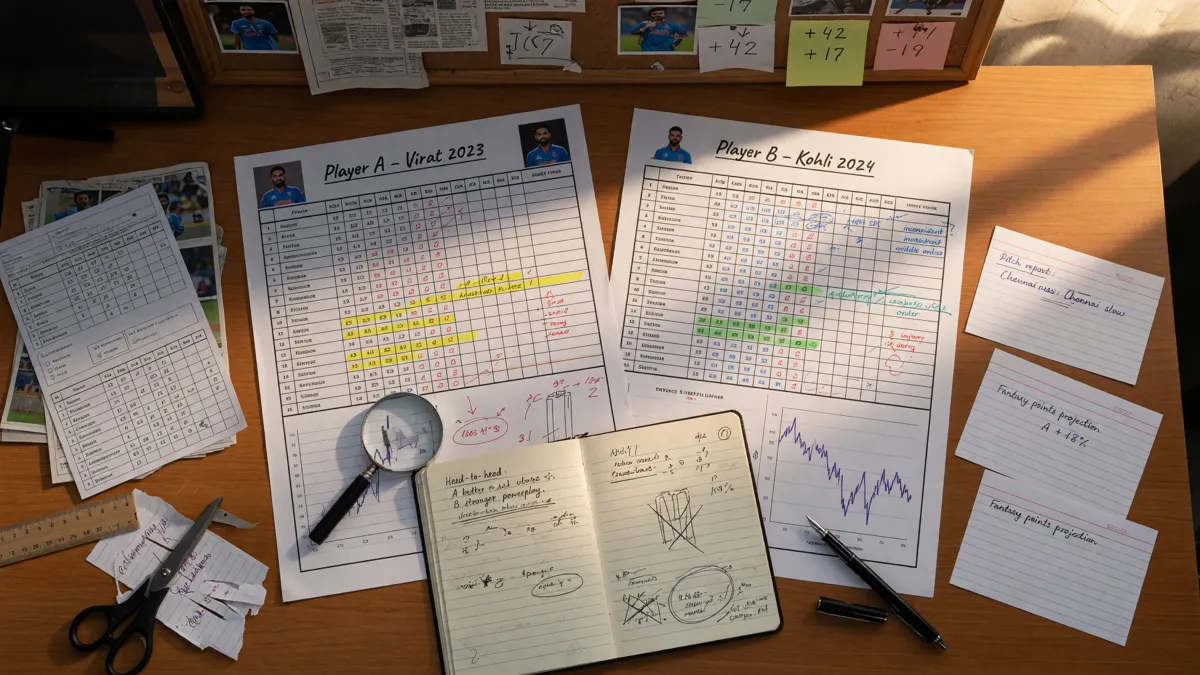
11Wickets verification matrix
Last full review · see Editorial Standards| Axis | Status | Verification | What may change |
|---|---|---|---|
| Operator identity | Provisional | Operator terms page; public registry data | Update when registry confirms |
| App availability | Provisional | Operator official domain / app store link | App store policy changes |
| KYC documents | Standard list | Operator help centre | Periodic KYC review cycles |
| Withdrawal method | Provisional | Operator terms + user reports | Operator policy updates |
| Scoring system | Provisional | Operator scoring table | Scoring changes per contest |
| Responsible play | Watch | Operator responsible-play page | Regulatory updates |
| Bonus / referral | Watch | Operator terms / in-app banner | Promotional cycles |
The honest limits of a single review
A review published today cannot speak for your account tomorrow. Operator terms change; bonus eligibility changes; KYC rules change. The desk’s job is to publish the frame at the moment of writing; your job is to verify the frame in your own account before you deposit. Treat any review — including this one — as a starting point, not a verdict.
Why no star rating?
A star rating collapses five axes into one number, and the collapse loses information. The matrix above keeps the axes separate.
Why no win-rate claim?
A win-rate claim requires a settled methodology, a long enough history and an honest denominator. The desk has none of those yet.
How often is this review updated?
When an underlying fact changes — operator identity, app store listing, terms, KYC rules. The date stamp tells you when.
No paid placement: This review is not a paid placement. The desk is not compensated by the operator for the content of this page. Affiliate links on the site are disclosed in the footer.
How to use this review
This review is a starting frame. Read it once. Then open the operator’s own page and confirm each axis — operator identity, app availability, KYC, scoring and responsible-play tooling. The five-axis matrix is the verification list. Tick each axis in your own account before you deposit.

What a good look at a platform feels like
A good look at a platform feels quiet. The terms are clear. The bonus conditions are visible on the same page as the bonus figure. The KYC list is short and achievable. Withdrawal timing is stated, not promised. The responsible-play page has tools, not slogans. Most of the platforms the desk has reviewed fall short on one or more of these axes; the matrix tells you which ones to check first.

How the verification matrix was built
The matrix is built by visiting the operator’s own page, the public ball-by-ball feeds, the broadcaster’s pre-match note (where relevant), and the regulator’s public registry. Each axis is assigned a status flag (Verified, Provisional, Watch) based on what could be confirmed in the time available. Re-checks flip the status flag; the date is always visible.
What the matrix deliberately does not cover
The matrix does not cover user-experience claims (how “easy” the app feels), marketing-quality claims, or sentiment-based ratings. These are subjective and not verifiable; the desk’s job is to publish what is verifiable. A user-experience review is a different artefact; the desk does not publish one.

How reviews can fail the reader
A review fails the reader in three ways: (1) it publishes invented figures to look authoritative; (2) it ranks platforms on subjective axes without naming the methodology; (3) it ignores the operator’s terms in favour of marketing copy. The desk’s review format is designed to avoid all three. If you read a review that does any of these, treat it as commentary, not as analysis.
What the review is not
The review is not a win-rate claim, a star rating, a recommendation to play or not play, or a guarantee of any kind. It is a dated, evidence-led status report across five axes. The reader’s job is to read the axes, weigh them in their own context, and make a decision in their own account. The desk’s job stops at the axes; the reader’s job starts there.
How reviews change over time
A review published today may be out of date in a month. Operators change terms; KYC rules change; bonus cycles change; regulatory frameworks change. The desk re-checks the verification matrix before every public update. If the date on the matrix is older than 30 days, treat the review as a starting frame, not as current evidence.
A final note from the desk
The review format is deliberately conservative. We do not publish win-rate claims, star ratings or platform rankings; we publish a verification matrix with five axes and dated status flags. A conservative review is more useful than a confident one because the reader’s job is to weigh the axes in their own context, not to defer to a verdict. The desk’s job is to publish the frame; the reader’s job is to make the call. This separation is the foundation of the editorial discipline.

Review discipline
A disciplined review stays useful over time because the axes are stable, the date stamps are visible, and the status flags flip when an underlying fact changes. A undisciplined review rots within weeks because the axes shift, the dates are missing, and the flags do not flip. The desk commits to the disciplined review format because the reader’s job is to use the review across weeks and months, not to read it once and discard it.
Questions readers ask
Is this review independent?
Yes. The desk is not paid for the content of this page. Affiliate routes elsewhere on the site are disclosed in the footer.
Should I trust a single review?
Use it as a starting frame, then verify in your own account. A review cannot replace account-level verification.
How do I submit a correction?
Use the contact page. We publish verified corrections in the open correction log within 7 days.
Open the editorial app entry
Verify the current offer in your own account, then play only what you can afford to lose.