
Two IPL offers can show the same headline percentage and mean two very different things. One credits a bonus balance that expires in seven days and can be withdrawn only after the wagering rules are met; the other credits withdrawable cash the moment a first deposit clears. The number on the banner is the smallest part of the deal, and the rest of the deal is what a careful reader should weigh before signing up.
This explainer walks through the seven things the desk checks on every IPL offer, trial credit and venue-linked promotion, with concrete examples clearly labelled as hypothetical and a decision framework a reader can apply without leaving the terms-and-conditions page. It is a working checklist, not a recommendation of any specific operator, and the closing section covers the responsible-use and legal context that should sit alongside any commercial decision.
Why comparison matters more than the headline
Indian fantasy-cricket operators run three broad offer types during the IPL window. The first is a sign-up bonus tied to a first deposit, usually expressed as a percentage match. The second is a trial credit — a fixed rupee amount added to a fresh account, often without a deposit, in exchange for completing identity verification. The third is a venue-linked deal, usually promoted at a stadium on a match day, which may add a free contest entry, a percentage top-up or a merchandise bundle to anyone who scans a QR code or signs up with a stadium-specific code. Each type has different eligibility, expiry and redemption rules, and a banner that says “100% up to ₹1,000” can apply to any of the three with very different economics behind it.
The desk’s first rule on offers is therefore simple: read the full terms before the headline. The seven checks below are what to look for, in the order that catches the most expensive surprises first. Each example below is hypothetical and is shown to illustrate the kind of clause to watch for; no current offer, code, price or expiry is being described.
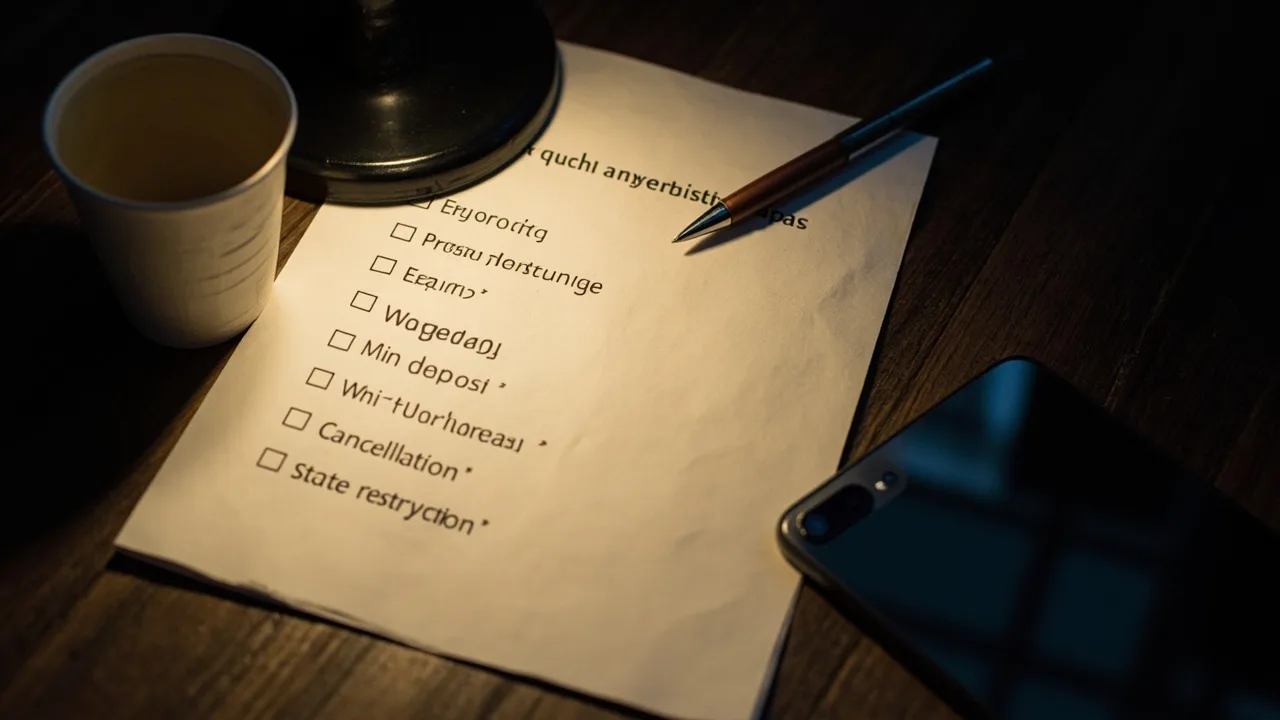
The seven checks, in priority order
These are the seven items the desk reads on every IPL offer page before forming a view on whether the offer is worth the deposit, the verification or the personal data. The list is not exhaustive, and the order is the order in which a missed clause is most expensive to the reader.
Eligibility and verification
Confirm the offer is open in your state of residence, that the operator holds a valid Online Gaming authorisation where required, and that the verification path (PAN, Aadhaar, age) is one you can complete within the offer window.
Expiry window
Read the exact start and end date and time. A seven-day window from first deposit is materially different from a 30-day window. Trial credits in particular often expire faster than deposit matches.
Redemption path
Check whether the credit is withdrawable cash, bonus balance or contest-entry only. Bonus balance almost always carries wagering rules; contest-entry offers usually cannot be converted to cash at all.
Wagering or playthrough
If the credit is bonus balance, confirm the playthrough multiplier (a “3x” rule means a ₹1,000 bonus must be staked ₹3,000 before any winnings can be withdrawn). Some offers allow partial withdrawal of winnings; others forfeit the bonus on first withdrawal.
Minimum deposit and payment rails
Confirm the minimum first deposit, the eligible payment methods (UPI, netbanking, cards), and whether the offer applies equally across all rails. A “100% on first deposit” offer that excludes UPI is effectively a different offer.
Exclusions and game types
Some offers restrict which contests the bonus balance can be used in (free contests only, or paid contests above a certain entry fee, or specific match types). Read the exclusion list before assuming the credit is general-purpose.
Cancellation and account-closure path
Confirm how the bonus balance is treated if you choose to close the account, withdraw early or self-exclude. Some operators void the bonus; others pay out the remaining bonus on a pro-rata basis. The cancellation clause is the one that matters most when something has already gone wrong.
Run the seven checks in this order, on a printed page or a notes file rather than on the operator app itself, and the headline percentage stops being the most important number on the page. The seven checks are the same for sign-up offers, trial credits and venue deals; what changes between the three offer types is which of the seven items is most likely to be the surprise.
Trial credits, and what they actually are
A trial credit is the offer type most often misunderstood by new users, because the headline “free ₹500” reads as a deposit match even though no deposit is required. The mechanics are different in three ways. First, a trial credit is almost always tied to a verification step — the operator credits the amount once PAN or Aadhaar is verified, not at sign-up. Second, the credit is usually bonus balance rather than withdrawable cash, which means it carries the wagering rules covered in check 4 above. Third, the trial credit window is shorter than a sign-up deposit match — seven days from credit is a common expiry, on a clock that starts when the verification clears rather than when the account is opened.
The practical comparison a reader should run is therefore between two hypothetical trial credits rather than against a deposit match. Suppose Operator A offers a ₹500 trial credit on PAN verification, with a 3x playthrough in 7 days, usable on contests with an entry fee of ₹10 or less. Suppose Operator B offers a ₹200 trial credit on PAN verification, with no playthrough, usable on any contest including the operator’s marquee contests. The second offer is smaller but withdrawable on first win with no further action. A reader whose plan is to play two large-field contests over the IPL week will often be better served by the second offer, even though the headline number is smaller, because the effective value per rupee of bonus is higher once the wagering rules and contest-type exclusions are accounted for.
Trial credits also carry one clause that deposit matches do not: the “one trial per person, household, device and payment instrument” rule. The wording is precise and is enforced more often than new users expect. Sharing a device with a sibling who has already redeemed a trial credit on the same operator, or using a payment instrument previously linked to another account, can void the credit even after verification. Read the eligibility language carefully and complete the verification on your own device, in your own name, on your own payment instrument.

Venue-linked deals, and why the asterisk matters
Venue-linked offers — the ones promoted on stadium concourses, in match-day programmes or via QR codes on official broadcast partners — are the offer type with the widest range of underlying terms. Some are extensions of the standard sign-up bonus, identical in every respect except for the entry code; others are entirely separate promotions with their own expiry, eligibility and redemption rules. The asterisk that always sits next to the headline on a printed venue poster is the single most important visual element on the page, because it points to the conditions that determine whether the offer is real for you.
Three venue-specific checks belong alongside the seven above. First, confirm whether the offer is exclusive to the venue (sign-up at the stadium on the day only) or extendable to the app (sign-up within 48 hours of the scan, for example). The exclusivity window is the part of the deal most often lost when a reader leaves the stadium and tries to claim the offer on the train home. Second, check whether the offer requires a minimum ticket purchase or a specific stand number — some venue deals require proof of entry that is harder to provide than the operator’s in-app verification. Third, confirm the payment rail. A venue offer that promises “free entry to the season-long contest” but requires a paid ticket purchase at the box office on the day is materially different from a venue offer that credits the contest entry directly to a new account.
The most common surprise on venue deals is the time zone. Match-day venue offers typically expire at midnight on the day of the match in the venue’s local time, which means a 7:30 PM IPL start at a North Indian venue often leaves only a four-and-a-half-hour window to complete the sign-up, verification and any deposit step. A reader who plans to use a venue deal should set aside the sign-up window in advance rather than assuming it can be done the next morning.
State eligibility and the legal frame
The single most important external check on any IPL offer is whether the operator is authorised to offer real-money fantasy contests in your state of residence. The Public Online Gaming Act, 2025 (PROG Act 2025) sets the central frame for online real-money gaming in India, and the Ministry of Electronics and Information Technology (MeitY) rules issued under it set the verification standards for registered users. Several state governments have additional permissions, prohibitions or verification requirements; an offer that is available to a reader in Bengaluru may not be available to a reader in a state where real-money fantasy contests are restricted, and the operator’s terms will usually reflect that.
The reader’s check is therefore not just “does the operator offer this in India?” but “does the operator offer this in my state, and is the verification it asks for (typically PAN plus state-level confirmation of age and residence) something I can complete cleanly?” A PAN is mandatory for any real-money fantasy account in India; some operators also require a state-specific confirmation step. An offer that requires verification steps the reader cannot complete will simply not credit, and a partial verification that times out can lock the bonus balance without unlocking it. State-level nuance — which states permit real-money fantasy contests this quarter and which do not — moves season to season; the Today’s Team desk note tracks the current permitted-and-restricted list alongside the desk’s daily brief.
The PROG Act 2025 also imposes advertising and disclosure rules on operators that affect how offers can be promoted. Banners that omit the responsible-play reminder, that quote a headline percentage without showing the wagering rules, or that direct users to a URL that does not match the operator’s registered domain are signals worth treating with the same caution as the seven checks above. The simplest defensive rule is to start every offer page at the operator’s registered URL, not via a shortened link from a banner or a third-party message.
Cancellation, withdrawal and the after-sign-up path
Offers are designed to be claimed, but every operator also publishes a path for not claiming — cancellation, account closure, self-exclusion and withdrawal of unspent balance. The cancellation clause is the one clause that matters more than any of the seven checks above once something has gone wrong, and it is the clause most readers skip on the way in.
Three questions cover the cancellation path. First, can the bonus balance be withdrawn on closure, or does it expire with the account? Most operators void the bonus on voluntary closure within the offer window; some convert it to a withdrawable amount on a pro-rata basis once the wagering rules are met. Second, what happens to the deposit that triggered the bonus if the reader changes their mind before wagering? UPI and netbanking rails allow reversal in many cases, but the operator’s policy on bonus-linked deposits is stricter than for ordinary deposits. Third, how does the operator handle a self-exclusion request during an active offer? Self-exclusion is a right the reader has under the PROG Act 2025 and the operator’s own responsible-play framework; the offer terms should not require forfeiture of deposited funds as a condition of self-exclusion, and any clause that does is a signal to walk away.
The after-sign-up path is also where responsible-play reminders sit. The desk’s standing rule is to read the responsible-play page once, on the day of sign-up, regardless of how confident the reader is in their own play. A reminder visible at the point of deposit is more effective than a reminder read after the fact.
A practical decision framework
The seven checks plus the trial-credit and venue-specific items give a reader a single workflow. The desk recommends the following five-step framework, applied in order, on every offer the reader considers during the IPL window.
State eligibility first
Confirm the operator is authorised in your state and that you can complete the verification cleanly. If the answer is no on either, stop. No offer is worth completing partial verification.
Type and headline
Identify the offer type (sign-up bonus, trial credit, venue deal) and the headline number. Note the headline, then move to the seven checks before forming any view on whether the offer is good value.
Run the seven checks
Eligibility, expiry, redemption, wagering, minimum deposit, exclusions, cancellation. Write each one down in a notes file. The exercise takes ten minutes and saves the most common sign-up mistakes.
Compute effective value
Estimate the effective value per rupee of your own deposit: headline percentage, minus the wagering friction, minus the contest-type exclusions. A 100% match with 5x playthrough on free contests only is rarely worth more than a 50% match with 1x playthrough on any contest.
Decide with a timer
Set a 24-hour timer before completing the sign-up. Most offer regrets the desk hears about happened within the first hour of seeing the banner. A 24-hour pause is the cheapest risk control in the workflow.
The five-step framework is intentionally conservative. Its purpose is not to find the best possible offer; its purpose is to avoid the worst sign-up mistakes, which are the ones where the reader commits a deposit, a verification and a partial bonus claim, then discovers the wagering rules only after the offer window has closed.
What the desk flags, and why
Three clauses on offer pages reliably signal a higher-than-average post-sign-up friction, and the desk flags them as “read twice before claiming.” The first is a wagering multiplier of 5x or higher on the bonus balance, which means the reader must stake five times the bonus before any winnings become withdrawable. The second is a withdrawal forfeit clause, where any withdrawal request during the offer window voids the bonus and any winnings attached to it. The third is a state-eligibility clause that lists a subset of states in the small print without a clear in-app state selector, because the reader who completes the verification in a non-listed state typically loses both the bonus and the deposit.
The desk also flags two positive signals. The first is an explicit “withdrawable from day one” clause on a credit, which removes the wagering calculation entirely. The second is an operator-published expiry calendar that shows each active offer’s exact end date in the user’s local time, rather than a generic “30 days from credit” line, because the local-time calendar makes the expiry check operational rather than aspirational.
Questions readers ask
Are IPL sign-up offers regulated in India?
Real-money fantasy-cricket offers sit inside the framework set by the Public Online Gaming Act, 2025 (PROG Act 2025) and the MeitY rules issued under it, plus state-level permissions or restrictions. An offer is only available to a reader if the operator holds a valid authorisation in the reader’s state of residence.
What is a “playthrough” or “wagering” rule on a bonus?
A playthrough rule says how many times the bonus amount must be staked before any winnings become withdrawable. A 3x rule on a ₹1,000 bonus means ₹3,000 must be staked in eligible contests before the winnings unlock. The rule is the single most common surprise on sign-up offers.
Why do trial credits expire faster than deposit matches?
Trial credits are designed to drive verification rather than deposits, and operators use a short expiry to compress the sign-up funnel. Seven days from verification is a common window; thirty days from first deposit is a common window for deposit matches.
Are venue-linked offers different from app offers?
Sometimes. Some venue offers are extensions of the standard sign-up bonus with the same rules; others are entirely separate promotions with their own expiry, eligibility and redemption rules. Always run the seven checks on a venue offer as if it were a new offer.
What happens to the bonus if I close the account?
Most operators void any unspent bonus balance on voluntary account closure. Some operators pay out a pro-rata amount once the wagering rules are met. The cancellation clause in the offer terms is the place where this is published; read it before you sign up.
Can I claim two trial credits from the same operator?
Almost always no. Trial credits are typically limited to one per person, household, device and payment instrument, and the rule is enforced more strictly than new users expect. The eligibility clause in the offer terms will state this explicitly.
Is the headline percentage the best way to compare offers?
No. Headline percentage is the least informative figure on the offer page. The effective value per rupee of your own deposit, after wagering rules and contest-type exclusions, is the better comparison. The framework above shows how to compute it.
The desk’s bottom line
An IPL offer, a trial credit and a venue-linked deal answer to the same seven checks, and the same five-step framework will help a reader decide whether the offer is worth the deposit, the verification or the personal data the sign-up collects. The headline percentage is the least informative figure on the page; the wagering rules, the expiry window and the cancellation path are the figures that decide whether the offer is good value in practice. Read the full terms once, on a printed page or a notes file, before completing the verification; set a 24-hour timer before the deposit; and treat the responsible-play page as part of the offer, not as a footnote.
The practical version of the rule is this: if the offer cannot survive ten minutes of reading and a 24-hour pause, the offer was never the right one. The seven checks and the framework above are how the desk runs that ten-minute read.
Verify the offer in your own account
Open the operator’s terms-and-conditions page, run the seven checks, set a 24-hour timer, then play only what you can afford to lose.